
All-on-X Dental Implants in Waltham, MA
Living with extensive tooth loss can affect nearly every part of daily life. Eating may become more difficult, speech can change, and concerns about loose or damaged teeth can make smiling feel uncomfortable. For patients who need to replace an entire upper or lower arch of teeth, All-on-X dental implants provide a full-arch solution designed to combine the stability of dental implants with a complete set of replacement teeth.
All-on-X Implants
At KoKo Dental Care in Waltham, MA, full-arch implant treatment is planned around the individual patient. The term All-on-X describes a treatment concept in which a complete dental restoration is supported by a strategically selected number of dental implants. The letter X represents the fact that the number of implants is determined by the patient’s anatomy, bone support, bite, treatment goals, and clinical needs.
Rather than assuming that every patient requires the exact same number of implants, All-on-X treatment allows the dental team to develop a personalized approach to rebuilding an entire smile.
What Is All-on-X?
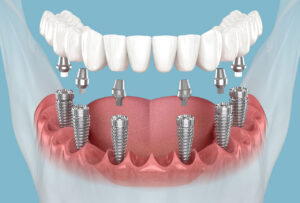
All-on-X is an implant-supported tooth replacement option for patients who are missing all or most of the teeth in one dental arch. Several dental implants are placed in strategic positions throughout the jaw and used as anchors for a full set of replacement teeth.
The restoration is generally designed as one connected prosthesis instead of individual crowns for every missing tooth. This can make it possible to replace an entire arch without placing an implant in every former tooth position.
The exact number of implants used can vary. Some patients may be treated with four implants, while others may benefit from additional implants depending on the condition of the bone, distribution of chewing forces, available space, and other clinical factors.
Who May Consider All-on-X Dental Implants?
All-on-X may be considered for patients who have already lost most or all of their teeth, as well as patients whose remaining teeth have extensive damage and may not offer a predictable long-term foundation.
Common situations that may lead someone to explore All-on-X include:
- Multiple missing teeth throughout an arch
- Severely damaged or failing teeth
- Difficulty chewing because of extensive tooth loss
- Loose or uncomfortable traditional dentures
- Frustration with denture adhesive
- Desire for a more stable full-arch tooth replacement
- Interest in a restoration supported by dental implants rather than the gums alone
Candidacy cannot be determined only by the number of missing teeth. The health of the gums, quantity and quality of available bone, medical history, medications, smoking habits, bite, and ability to maintain the restoration all influence treatment planning.
How All-on-X Dental Implants Work
Traditional dentures rest primarily on the gums. All-on-X restorations use dental implants placed within the jaw as their foundation. These implants create anchor points that help stabilize the replacement teeth.
The implants are distributed strategically across the dental arch to help support chewing forces. After implant placement and appropriate healing, the final restoration is connected to the implants.
Because the restoration replaces multiple teeth as a single prosthetic structure, the dental team evaluates much more than individual tooth spaces. Facial proportions, bite height, lip support, smile line, tooth size, speech, jaw relationship, and chewing function may all influence the design.
The All-on-X Treatment Process
The first stage is a comprehensive evaluation. The dental team examines the teeth, gums, bite, bone structure, and overall oral health. Three-dimensional imaging may be used to evaluate the jaw and plan potential implant positions.
If natural teeth remain, the team determines whether any can predictably be preserved or whether removal should be considered as part of the treatment plan. Gum infection, decay, or other dental problems may also need to be addressed.
Once the plan is established, implants are placed in carefully selected locations. Depending on the individual situation, a temporary restoration may be discussed while the implants heal.
After the implants have achieved appropriate stability and healing, the final full-arch restoration is designed and attached. Adjustments may be necessary as the team evaluates comfort, bite, speech, appearance, and cleaning access.
Every treatment plan is different, so the number of appointments and overall sequence can vary.
Benefits of All-on-X Dental Implants
- Full-arch tooth replacement: All-on-X is designed to replace an entire upper or lower set of teeth.
- Implant stability: The restoration receives support from implants positioned within the jaw rather than depending only on the gums.
- Fewer implants than individual tooth replacement: A complete arch can often be supported without placing one implant for every missing tooth.
- Improved chewing confidence: A stable implant-supported restoration may help patients feel more comfortable during meals.
- Natural-looking smile design: Replacement teeth can be designed with facial proportions, tooth shape, shade, and smile appearance in mind.
- No traditional denture adhesive: Implant support reduces reliance on adhesive to hold a full restoration in place.
- Customized implant number: All-on-X allows the number and position of implants to be selected according to the patient’s anatomy and treatment needs.
- Comprehensive rehabilitation: Treatment can address appearance, missing teeth, bite function, and extensive dental deterioration as part of one coordinated plan.
All-on-X vs. All-on-4
All-on-4 is a specific full-arch implant concept that uses four implants to support a complete restoration. All-on-X is a broader term that does not require the treatment to use exactly four implants.
For one patient, four implants may provide the appropriate distribution and support. For another, the dentist may determine that a different number of implants is preferable based on available bone, bite forces, arch shape, or other factors.
The goal is not simply to use the fewest or greatest number of implants. The goal is to create a treatment plan appropriate for the individual patient’s anatomy and long-term restorative needs.
All-on-X vs. Traditional Dentures
Traditional dentures and All-on-X restorations can both replace an entire arch, but they function differently. Traditional dentures rest on the gums and may rely on suction or adhesive for retention. They are removed by the patient for cleaning.
All-on-X treatment relies on dental implants for support. Many All-on-X restorations are fixed in place and are removed only by a dental professional when necessary, although the exact design should be discussed during treatment planning.
Traditional dentures may be appropriate for patients who want a removable option or are not candidates for implant surgery. All-on-X may appeal to patients seeking greater stability and a restoration supported by implants.
All-on-X vs. Snap-in Dentures
Both treatments use dental implants, but snap-in dentures and All-on-X restorations are usually designed differently.
A snap-in denture attaches to implants for added stability but remains removable by the patient. This can make cleaning straightforward because the appliance can be removed from the mouth.
An All-on-X restoration is commonly designed as a fixed full-arch prosthesis. Patients clean around and beneath the restoration using specialized hygiene techniques rather than removing it daily.
Choosing between them depends on desired stability, cleaning preferences, bone anatomy, treatment goals, cost considerations, and whether a fixed or removable restoration is preferred.
Can Teeth Be Provided the Same Day as Implant Placement?
Some full-arch implant treatment plans allow a temporary restoration to be attached around the time implants are placed. However, immediate temporary teeth are not appropriate in every situation.
The ability to provide an immediate restoration depends on factors such as implant stability, bone quality, bite forces, healing conditions, and the specifics of the treatment plan. Even when temporary teeth are placed early, healing instructions and dietary restrictions are important because the implants still require time to integrate with the jaw.
The final restoration is generally created after appropriate healing and evaluation.
What Happens If Bone Loss Is Present?
Bone loss is common in people who have been missing teeth for an extended period. It can also occur because of gum disease, infection, or previous dental problems.
Three-dimensional imaging helps the dental team evaluate where adequate bone is available and whether additional procedures may be recommended. The ability to strategically position multiple implants can sometimes help the dentist work with the strongest available areas of the jaw, but this does not eliminate the need for individualized planning.
Bone grafting or other procedures may still be recommended when necessary.
Cleaning and Maintaining All-on-X Teeth
Although replacement teeth cannot develop cavities in the same way natural enamel can, the implants and gum tissue still require excellent hygiene. Plaque and bacteria can accumulate around implant components, so cleaning beneath and around the restoration is essential.
Patients may be instructed to use floss threaders, interdental brushes, water flossers, or other tools designed for implant restorations. Professional maintenance visits also allow the dental team to evaluate the gum tissue, implants, bite, prosthesis, and cleaning access.
A long-term maintenance routine should be considered part of All-on-X treatment from the beginning.
Why Choose KoKo Dental Care for All-on-X in Waltham?
Full-arch dental implant treatment requires detailed evaluation, careful implant planning, restorative design, and ongoing maintenance. At KoKo Dental Care, patients exploring full-mouth tooth replacement can receive a personalized evaluation focused on both oral health and quality of life.
Modern dental imaging can help the team understand the three-dimensional structure of the jaw before treatment. Just as importantly, patients can discuss the differences among traditional dentures, snap-in dentures, All-on-4, All-on-X, and other implant-supported options.
This comparison helps you understand why a specific treatment is being recommended rather than selecting an option based only on a treatment name.
Explore Full-Arch Dental Implant Treatment in Waltham
If extensive tooth loss is making it difficult to eat, speak, or smile comfortably, All-on-X dental implants may provide a way to rebuild an entire arch with the stability of implant support. The right treatment begins with understanding your bone structure, oral health, goals, and the different fixed and removable options available to you. To take the next step and find out whether All-on-X may be appropriate for your smile, call KoKo Dental Care in Waltham, MA at (781) 810-4661 to request a full-arch dental implant consultation.
-
What does the X in All-on-X mean?
The X represents a variable number of dental implants. Instead of requiring every patient to receive the same number, implant quantity is determined according to individual anatomy and treatment needs.
-
Is All-on-X the same as All-on-4?
No. All-on-4 specifically refers to a restoration supported by four implants. All-on-X is a broader concept that may use four or another appropriate number of implants.
-
Can All-on-X replace both upper and lower teeth?
Yes. Full-arch implant treatment can be planned for the upper arch, lower arch, or both when clinically appropriate.
-
Are All-on-X teeth removable?
Many All-on-X restorations are designed to remain fixed in place and are removed by a dental professional when necessary. Your dentist will explain the specific design recommended for your treatment.
-
Can I get All-on-X if I currently wear dentures?
Denture wearers may be evaluated for All-on-X. Bone levels, gum health, medical history, and other clinical factors determine whether implant-supported treatment is appropriate.
-
How do I clean All-on-X teeth?
Daily cleaning is required around the implants and beneath the restoration. Specialized floss, small brushes, water flossers, and professional implant maintenance may be recommended.